

The shift usually doesn’t announce itself. There’s no single moment where mobility starts slipping. Instead it shows up in small things. The grocery bags feel heavier than they used to. Getting off the floor after playing with grandkids takes a second more than it should. The hallway carpet that you’ve walked over for 20 years suddenly catches your toe. The first time it happens, you laugh it off. The second time, you start paying attention.
That paying-attention moment is the right time to read this. Not after the fall. Not after the surgery. Not when independence has already started getting renegotiated with adult children who suddenly want to talk about “options.” Now. Because mobility is one of the few things in aging where the work you do in your 50s, 60s, and early 70s genuinely determines how the rest of it goes.
This guide is for two readers. The aging adult who wants to stay in their own home, on their own terms, for as long as possible. And the adult child reading this for their parent, trying to figure out what to actually do before something breaks. Both groups get the same honest answer about where chiropractic care fits, what the evidence supports, and what else needs to be in the plan.
The Numbers That Should Get Your Attention
Before we talk about what helps, here’s what’s at stake. According to the CDC, more than one in four adults aged 65 and older falls each year. Falls are the leading cause of injury-related death in this age group, and the death rate has climbed 21 percent in the last six years alone. About 3 million older adults end up in emergency departments every year because of a fall, and about a million are hospitalized. More than 95 percent of hip fractures are caused by falls.
Less than half of people who fall tell their doctor about it. That’s the number that should bother you the most, because falling once doubles your odds of falling again. The medical system can’t help you prevent something it doesn’t know happened.
Here’s the part that often gets missed in the fall statistics. Most falls are not random. They are the predictable consequence of muscle weakness, joint stiffness, poor balance, slower reaction time, and medication side effects, all of which are addressable. Not every fall can be prevented, but most of the risk can be reduced significantly through the right combination of movement, strength work, environmental changes, and conservative care.
Why Mobility Slips
Aging affects the body in real, measurable ways. Joint cartilage thins. Spinal discs lose hydration. Muscle mass declines (a process called sarcopenia) at roughly 3 to 8 percent per decade after 30, and the rate accelerates after 60. Bone density decreases. Reflexes slow. Posture changes.
None of that is preventable in the absolute sense. What is preventable, or at least slowable, is how much function you lose to those changes. Most of what people call “normal aging” is actually the compound effect of decades of inactivity, ignored injuries, and untreated movement patterns. A 70-year-old who has stayed active and dealt with their aches and pains as they came up is in a fundamentally different physical position than one who didn’t.
The four biggest mobility drains we see in the clinic are: stiff thoracic spine (the mid-back), which makes everything from breathing to reaching overhead harder; restricted hip and ankle mobility, which changes how you walk and balance; chronic compensations from old injuries that were never fully resolved; and a slow withdrawal from activities that maintain balance and proprioception. Every one of those is addressable, but it gets harder the longer you wait.
Where Chiropractic Care Actually Fits in Healthy Aging
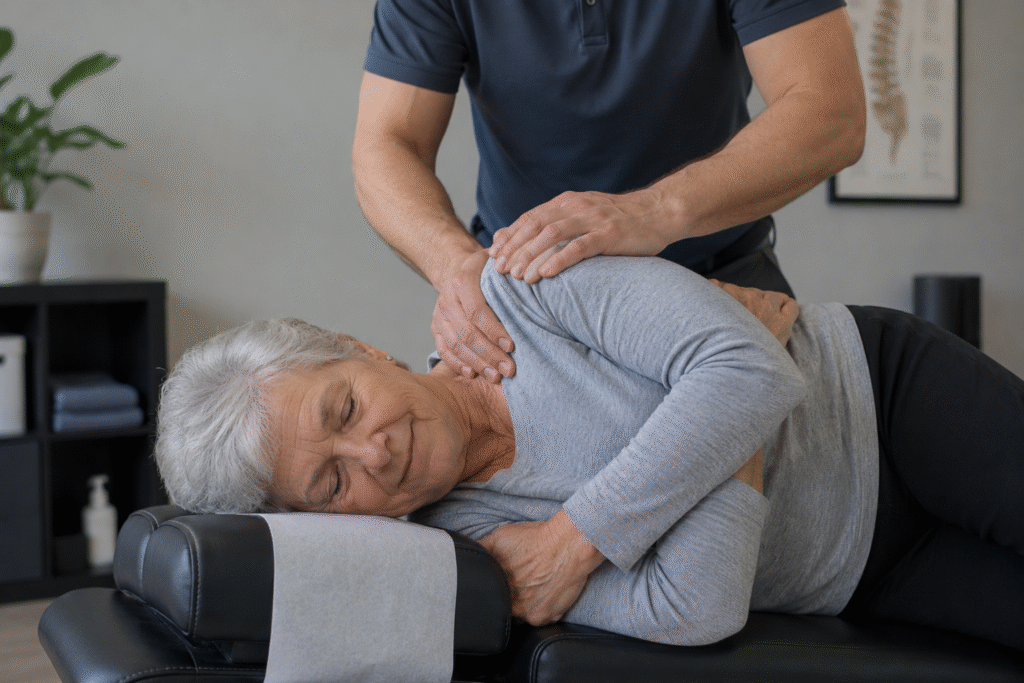
Chiropractic care is not a miracle solution for aging. Anyone selling it that way is overpromising. What it can do, when paired with the other pieces, is keep the musculoskeletal system moving better than it would otherwise, which has downstream effects on balance, comfort, and confidence.
Joint mobility maintenance
The spine and major joints lose range of motion with age, partly from disuse and partly from the cumulative effect of small injuries that never fully resolved. Gentle, targeted adjustments paired with myofascial therapy can help maintain the mobility you have and recover some of what’s been lost. This is mechanical work, not anti-aging magic. But for a 68-year-old who can suddenly reach the top shelf again or get out of a chair without rocking forward three times to build momentum, the practical difference is real.
Pain management without medication risk
Chronic back, neck, and joint pain are common in older adults, and the default medical response has historically been medication. The problem is that pain medications, including NSAIDs and opioids, carry meaningful risks at any age and significantly higher risks for older adults. A 2025 study of Medicare beneficiaries published in the Journal of Manipulative and Physiological Therapeutics found that older adults with new neck pain who received chiropractic care had 20 percent lower rates of adverse outcomes compared to those who received prescription drug therapy. That’s a real, peer-reviewed finding, and it matters.
Movement screening and corrective exercise
A good chiropractor working with older adults isn’t just adjusting. They’re looking at how you move, where you’re compensating, and what exercises will keep small problems from becoming bigger ones. Rehab and corrective exercise is arguably the most important piece of conservative care for aging adults, and it’s the piece most chiropractic offices either skip or do poorly.
Posture support
The forward-leaning posture that develops with age (sometimes called kyphosis) doesn’t just look like aging. It changes how the diaphragm works, how the shoulders move, and how the eyes track the horizon, all of which affect balance. Addressing the mobility restrictions and muscle imbalances behind it can slow or partly reverse the pattern.
Coordination with the broader plan
Chiropractic care alone is not a fall prevention program. The strongest evidence for preventing falls in older adults points to a multi-component approach: strength training, balance work, vision checks, medication reviews, and home safety assessments. Chiropractic can support the movement and pain pieces, but it should sit inside a broader plan, not pretend to replace one.
What Conservative Care Actually Looks Like for an Older Adult
If you’ve been hesitant about chiropractic care because you have an image of aggressive cracking and twisting, that’s a reasonable hesitation. For older adults, especially those with osteoporosis, prior surgeries, or other complicating conditions, that style of care would be genuinely inappropriate. The good news is that’s not what modern care for older adults looks like.
A first visit with Dr. Klein for someone in their 60s, 70s, or 80s starts with a thorough history. What does your day look like? What are you doing now that you could not do five years ago? What scares you about your own movement? What medications are you on, what surgeries have you had, do you have osteoporosis or osteopenia? These questions shape everything that comes next.
The movement assessment is gentle and practical. How do you get out of a chair? Can you turn your head fully both directions? How is your balance on one foot? How do you walk down a hallway? These are real-world functional tests, not academic ones.
Treatment for older adults uses lower-force techniques that respect what the body can and cannot tolerate. Instrument-assisted adjustments, mobilization, and soft tissue work often do more of the heavy lifting than high-velocity manipulation. The goal is to restore movement, not to demonstrate force.
Homework matters more for older adults than for any other patient group. Adjustments without follow-up exercise tend not to hold. A few minutes of targeted mobility and strength work daily is what locks in the gains and builds the resilience that protects against falls and injuries.
What Chiropractic Care Won’t Do (and What You Need Instead)

Honest care includes being clear about limits. Chiropractic care won’t replace the other pieces of healthy aging, and any provider who suggests otherwise is overselling.
It won’t build strength. Strength training does that, and it’s non-negotiable for aging well. Two or three short sessions a week of progressive resistance training do more for your independence than almost any other single intervention. If you’re not strength training and you’re over 60, that’s the highest-value change you can make.
It won’t replace medical care. Annual checkups, medication reviews, vision and hearing checks, and management of conditions like diabetes, heart disease, and osteoporosis all need to happen through your primary care provider and any specialists you see. Chiropractic care complements those, never substitutes.
It won’t fix balance on its own. Balance is trainable, and it improves with practice. Tai chi, specific balance exercises, and programs like the CDC’s STEADI program are well-supported tools. Chiropractic can support the mechanics that make balance work easier, but the balance work itself still needs to happen.
It won’t address every cause of mobility loss. Conditions like Parkinson’s disease, severe arthritis, peripheral neuropathy, and post-stroke recovery often need specialized care that chiropractic isn’t designed to provide. A good chiropractor recognizes when to refer out.
A Practical Plan for Staying Mobile
If you’re in your 50s, 60s, or 70s and want to give yourself the best shot at staying independent, here’s the framework. None of this is exotic. The hard part isn’t knowing what to do, it’s actually doing it consistently.
- Strength train twice a week. Even short sessions count. Bodyweight exercises, resistance bands, or light dumbbells are all fine starting points. Progressive overload over time matters more than perfect form on day one.
- Walk daily. Twenty to thirty minutes most days. Outside if you can, treadmill if you can’t. This isn’t optional infrastructure for healthy aging.
- Practice balance work. Single-leg standing while brushing teeth, heel-to-toe walking down a hallway, tai chi class once a week. Five minutes of intentional balance work daily compounds quickly.
- Address pain before it limits you. Don’t wait until something hurts so badly you stop walking. Catch it early through conservative care.
- Review medications annually. Some common prescriptions increase fall risk significantly. Ask your primary care provider whether any of yours could be adjusted.
- Make your home safer. Remove throw rugs that aren’t anchored, add grab bars in the bathroom, improve lighting at night, clear walkways. Boring fixes prevent dramatic outcomes.
- Get your vision and hearing checked. Both contribute to balance and awareness. Updates to glasses or hearing aids can meaningfully reduce fall risk.
- Tell your doctor when you fall, even if you weren’t hurt. Falls that didn’t injure you are still data that should be in your medical record.
For the Adult Children Reading This
If you’re reading this because you’re worried about a parent, here’s the honest framing. The mobility conversation is one of the hardest ones to have with an aging parent, and timing it well matters more than getting the script perfect.
The wrong time to have it is right after a near-fall or a scare, when emotions are high and the parent feels their independence being questioned. The right time is during a calm moment, framed around the parent’s own goals (staying in their home, traveling, playing with grandchildren), not your fears. The framing matters: “I want to help you stay independent as long as possible” lands very differently than “I’m worried about you.”
Practical help looks like offering to drive to appointments, helping with home modifications, joining them on walks, or finding strength and balance classes designed for older adults. Chiropractic care, where appropriate, fits in as one piece of that plan. Going with them to a first visit can also help, because two sets of ears in a healthcare appointment is always better than one.
Start Where You Are
Mobility loss is not inevitable in the way many people assume. Yes, the body changes. But how much function you keep, and how long you keep it, is largely up to you and the decisions you make in the years before you actually need to. The work you do at 60 sets up what’s possible at 75. The work you do at 75 sets up what’s possible at 85.
If you’re an aging adult in the Cedar Park area who’s noticed mobility starting to change, or an adult child trying to help a parent stay ahead of it, an evaluation with Dr. Klein is a conservative, low-risk place to start. Care is tailored to what your body can tolerate, the goals you actually have, and the realities of where you are right now. Call (512) 501-6941 or book online.
Frequently Asked Questions
Is chiropractic care safe for seniors and older adults?
Yes, when care is appropriately tailored. Older adults benefit from gentler techniques, lower-force methods, and a thorough understanding of conditions like osteoporosis and prior surgeries. A 2025 study of Medicare beneficiaries found that older adults receiving chiropractic care for neck pain had lower rates of adverse outcomes than those receiving prescription drug therapy. Safety in older adults is primarily about technique selection and provider experience, not about whether chiropractic itself is appropriate.
At what age should I start seeing a chiropractor for mobility?
There’s no specific age. The better framing is to start before mobility issues become limiting. Many people benefit from establishing care in their 50s or 60s, when small problems can still be addressed before they become bigger ones. Starting later still helps, but the gains tend to be slower and the goals more about maintenance than recovery.
Can chiropractic care prevent falls?
It can support the pieces that contribute to fall risk, including mobility, posture, and pain that may be affecting how you walk. But fall prevention is multi-component, and the strongest evidence supports combining strength training, balance work, vision checks, medication reviews, and home safety improvements alongside any conservative care. No single intervention prevents falls on its own.
Will Medicare cover chiropractic care?
Medicare Part B covers chiropractic spinal manipulation when medically necessary to correct a subluxation. It does not cover x-rays, exams, or other services performed by chiropractors in most cases. Coverage varies by plan, especially for those with Medicare Advantage. Our office can verify your specific coverage and out-of-pocket costs before your first visit.
What if my parent has osteoporosis?
Chiropractic care can still be appropriate, but technique selection becomes much more important. Higher-force manipulation is typically avoided, and lower-force methods (instrument-assisted adjustments, mobilization, soft tissue work) are used instead. Always disclose an osteoporosis diagnosis and any bone density scan results during the first visit so care can be planned safely.
How often should an older adult see a chiropractor?
It depends on what’s being addressed. Active issues may need more frequent visits at the start, often once or twice a week for a few weeks. Maintenance care for older adults often settles into a cadence of once or twice a month, sometimes less. Any provider recommending a long pre-paid plan on day one without reassessment points should be questioned.
Can a chiropractor help with arthritis pain?
Conservative care including chiropractic adjustments and soft tissue work can help manage arthritis symptoms by improving joint mobility and reducing surrounding tension. It doesn’t reverse the underlying joint degeneration, but it can meaningfully improve daily function and reduce pain in many cases. Coordinating with your primary care provider or rheumatologist is part of a good plan.