
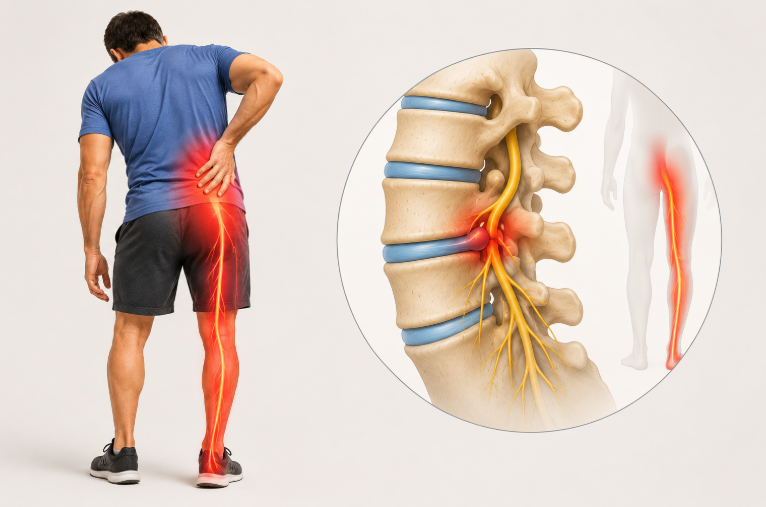
Sciatica is not a diagnosis. It’s a symptom. The word describes pain that radiates from the lower back or buttock down the leg along the path of the sciatic nerve, and that pain can come from at least half a dozen different underlying causes. Which one is driving your sciatica matters, because the treatment for a disc-related case looks meaningfully different from the treatment for a piriformis case, and both look different from what you’d do for stenosis or an SI joint problem.
What Sciatica Actually Is
The sciatic nerve is the largest nerve in the body. It’s formed by nerve roots exiting the lumbar and sacral spine (L4 through S3), and it runs from the lower back through the deep buttock, down the back of the thigh, and branches into the calf and foot. When any part of that path gets irritated or compressed, the nerve signals pain, and the pain typically follows the nerve’s route: lower back, buttock, back of thigh, sometimes into the calf, sometimes all the way to the foot.
In the clinic, we see the same complaint (“pain shooting down my leg”) from patients with completely different underlying causes, and giving them all the same treatment plan produces uneven results. Sorting out which cause is driving your symptoms is where treatment starts.
The Disc Scenario
The most common cause of true sciatica is a lumbar disc pressing on a nerve root. Discs are the cushions between the vertebrae in your lower back. Each one has a tough outer wall and a softer center. When that outer wall weakens or tears, the center can push outward, and if it pushes into the narrow channel where a nerve root exits the spine, two things happen: the material presses on the nerve, and it releases inflammatory chemicals that irritate it further.
The two lowest discs are the usual culprits, because they carry the most mechanical load. Which one is involved changes where you feel the pain, and that pattern is one of the clearest signs a disc is behind your symptoms:
- The second-to-last disc (L4-L5) irritates the L5 nerve root. Pain runs down the outer leg to the top of the foot and the big toe.
- The last disc (L5-S1) irritates the S1 nerve root. Pain runs down the back of the leg to the heel and the outer edge of the foot.
Each nerve root serves a specific strip of skin, so the location of your leg pain points back to the level where the problem started. This is why your chiropractor will ask exactly where the pain travels and which toes are involved, rather than just noting that your leg hurts.
What a Disc-Related Sciatica Case Typically Looks Like
The classic story: the patient has a history of low back pain, sometimes for years, sometimes for weeks. At some point, often after lifting, twisting, or bending forward but sometimes with no clear trigger, the back pain suddenly extends into the leg. Within a few days the leg pain becomes worse than the back pain, and it follows a specific line down the leg rather than aching everywhere.
Sitting makes it worse, along with bending forward, coughing, sneezing, straining on the toilet, and long drives. Standing, gentle walking, and lying on your back with your knees supported tend to help. Many patients notice the pain is worst first thing in the morning, because discs absorb fluid overnight and are more pressurized when you wake up.
One test does most of the diagnostic work. Lie flat on your back and have someone slowly lift the affected leg, keeping the knee straight. In disc-related cases, this reproduces the leg pain somewhere between 30 and 70 degrees of elevation. It is the most reliable clinical sign available without imaging.
Sensory changes matter too. Numbness or tingling in a defined patch (a strip along the outer thigh, the top of the foot, the big toe) points to nerve root involvement rather than muscle-referred pain. Actual weakness, meaning trouble lifting your toes or your foot slapping the ground when you walk, points to more significant compression and deserves prompt evaluation.
The Piriformis Scenario
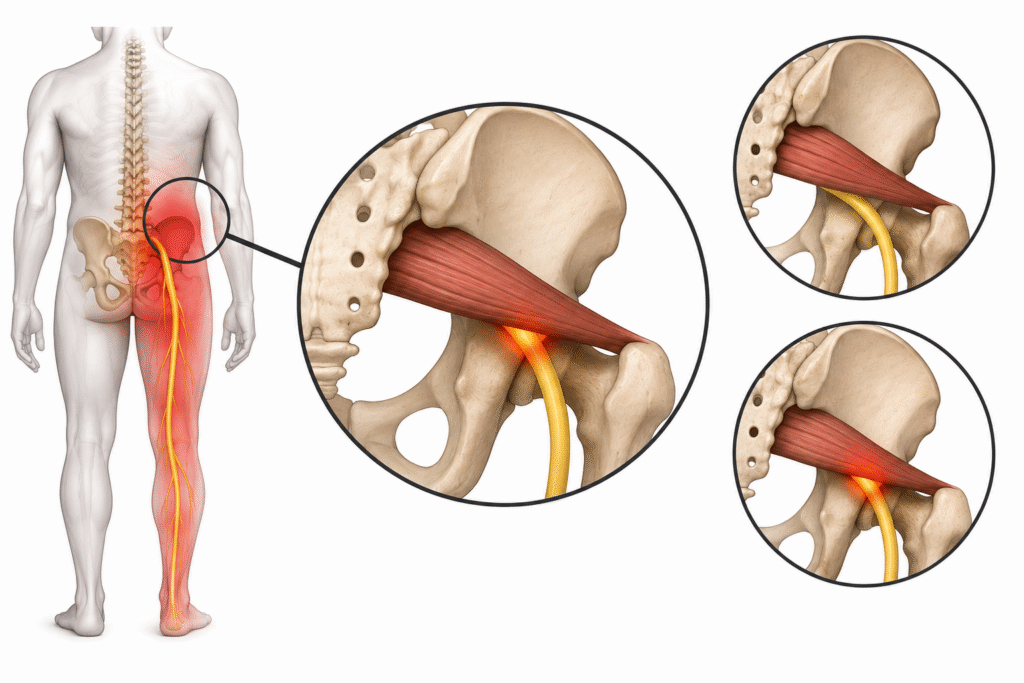
The piriformis is a small, deep muscle in the buttock. It runs from the base of the spine to the top of the thigh bone and helps rotate the hip outward. The sciatic nerve passes underneath it, and in roughly 15 to 20 percent of people it passes directly through the muscle. When the piriformis is chronically tight, spasmed, or inflamed, it can squeeze the sciatic nerve where the two meet in the deep buttock.
The result is leg pain from the same nerve, but with a completely different origin. The irritation is muscular, not spinal, and that changes what the pain feels like, what sets it off, and what calms it down.
What a Piriformis Case Typically Looks Like
The classic story: deep buttock pain the patient can point to with one finger, right in the middle of one glute. It often radiates down the back of the leg, but it rarely passes the knee, and it does not follow the tidy line that disc cases do. Numbness and tingling can happen but are usually milder.
The most telling feature is what is missing. Piriformis cases usually involve little or no low back pain. If your complaint is buttock and leg pain with a back that feels fine, that points hard toward the muscle. Disc cases almost always bring significant back pain along with the leg symptoms.
Prolonged sitting makes it worse, especially on hard surfaces or with a wallet in the back pocket. So do crossing your legs, long drives, stairs, and running or walking uphill. Cyclists, runners, and people who drive for a living show up in this category far more often than average.
Standing up, walking around, lying on the unaffected side with a pillow between the knees, and targeted piriformis stretches all tend to help. That last one is a diagnostic clue in itself. Piriformis cases often improve noticeably with the right stretch. Disc cases usually do not.
In the office, we confirm it by putting the hip in the position that stretches the piriformis and by testing rotation against resistance. Neither test is as dependable as the straight leg raise is for discs, but a positive result alongside the pattern above builds a solid case.
The Four Questions That Separate Them
Perfect self-diagnosis is not possible at home, but four questions do most of the sorting:
- How much back pain? Significant back pain with the leg symptoms points to disc. Buttock and leg only points to piriformis.
- Does coughing or sneezing shoot pain down your leg? Yes points strongly to disc. A muscle compressing the nerve does not react to abdominal pressure.
- Does the straight leg raise reproduce it? Reliably, between 30 and 70 degrees, points to disc. Lifting the leg high with little response points away from it.
- Do piriformis stretches help? Clear relief points to piriformis. No change or a flare-up points back toward disc.
Answers that cluster on one side usually mean that is what you are dealing with. Mixed answers can mean both at once, which does happen, or one of the less common causes further down.
What Chiropractic Care Actually Does for Sciatica
Chiropractic care is a reasonable first stop for most sciatica, and for the majority of cases it is the only care that ends up being needed. Around 80 to 90 percent of sciatica resolves without surgery. The work is not one adjustment repeated until the pain gives up. It is a sequence: find the source, take pressure off the nerve, restore normal movement, then fix the pattern that caused it.
The First Visit
The first appointment is mostly diagnostic. Dr. Klein takes a detailed history, and the questions are specific for a reason: where exactly the pain travels, which toes are involved, what you were doing when it started, what position gives you relief. Then comes a movement screen to see which directions provoke the symptoms, a neurological screen checking reflexes, muscle strength, and sensation in the areas each nerve root supplies, and the orthopedic tests described above to separate disc from muscle.
You leave with a working diagnosis, a plan, and a timeline. If the exam turns up something that belongs with a different provider, you leave with that instead, along with the referral.
For Disc-Related Sciatica
The goal is to reduce pressure and inflammation around the nerve root and get the joints above and below it moving properly again. When one segment of the lower back stops moving, the segments around it absorb the extra load, which is often what set up the disc problem in the first place. Restoring motion there takes the repeated stress off the injured level.
In the acute phase, that means gentle mobilization rather than a forceful adjustment. Table-based traction techniques can create a small amount of space at the level where the nerve exits, which many patients feel relief from during the visit itself. Soft tissue work releases the muscles that have been guarding and spasming around the injury. Gentle nerve gliding exercises restore normal movement of the nerve inside its sheath, and these get dosed carefully, because pushing them too hard flares symptoms.
As the acute pain settles, care shifts toward core and hip strengthening so the lower back is supported by muscle instead of relying on the joints. Typical frequency is two to three visits a week for the first two or three weeks, tapering as symptoms improve.
For Piriformis-Related Sciatica
Different problem, different plan. Because the compression is muscular, the work centers on releasing the piriformis and correcting what keeps tightening it. Soft tissue work directly on the piriformis and the deep hip rotators around it does most of the heavy lifting, paired with a stretching protocol you run at home between visits.
From there it is mechanical. Hip and pelvis mobility work, adjustments to the sacroiliac joint and lower back when they are restricted and pulling on the muscle, and changes to the postures that keep re-tightening it: how you sit at work, how you sit in the car, how you run. Strengthening the surrounding hip stabilizers matters more than most patients expect, because a weak gluteus medius leaves the piriformis compensating on every step.
Piriformis cases often turn around quickly, sometimes within a handful of visits. A case that has not improved in four to six weeks usually means the diagnosis needs another look.
What Recovery Actually Looks Like

Honest expectations matter, because wrong ones are the reason people abandon a plan two weeks before it would have worked. The general arc:
• Sharp acute symptoms settle within two to four weeks. Not gone, but well off the worst days.
• Normal function, meaning you can sit, walk, work, and sleep without organizing your day around the pain, usually arrives between four and eight weeks.
• Residual numbness or tingling can linger two to three months. That is not a sign you are not healing. Nerve tissue simply repairs slowly compared to muscle.
In both scenarios, avoiding prolonged rest is the rule. Movement heals and bed rest does not. Modify the specific activities that provoke symptoms and keep moving as much as you tolerate. And in both, the last phase of care addresses the posture, movement habits, and strength gaps that set the injury up, which is the part that keeps it from coming back next year.
Cases not showing meaningful improvement after four to six weeks of consistent care warrant reassessment, sometimes with imaging, and possibly a change in approach or a referral.
When It’s Something Else Entirely
Disc and piriformis are the two heavyweights, but a handful of other conditions produce similar symptoms:
• Spinal stenosis. Narrowing of the spinal canal from arthritic changes over years. Symptoms get worse with standing and walking and better when you sit or lean forward on a shopping cart. Common in older adults and usually needs imaging to confirm.
• A slipped vertebra. One vertebra shifts forward on the one below it, narrowing the space where nerves exit. An X-ray shows it.
• SI joint dysfunction. The joints where the base of the spine meets the pelvis refer pain into the buttock and down the leg convincingly enough to fool patients and providers. The sciatic nerve is not actually involved. Specific joint tests sort it out.
• Facet joint irritation. The small joints linking the vertebrae get inflamed and refer pain into the buttock and thigh, usually stopping above the knee. Bending backward or twisting aggravates it.
• Rare but serious causes. Tumors and infections occasionally present as sciatica. Uncommon, but they change the urgency, which is why the red flags in the next section matter.
When You Actually Need Imaging
Most sciatica does not need imaging upfront, which surprises patients. The clinical picture is usually clear enough to start treatment, and most cases resolve before a scan would change anything. Imaging earns its place in specific situations:
• Loss of bowel or bladder control, or numbness in the area that would contact a saddle. This is a medical emergency. Go to an emergency room rather than waiting on a scan.
• Significant or worsening weakness, such as a foot that slaps the ground or a calf that cannot push off.
• No improvement after four to six weeks of consistent conservative care, or symptoms getting steadily worse during it.
• Symptoms that started with real trauma, like a fall or a car accident.
• A cancer history, unexplained weight loss, or fever alongside new back or leg symptoms.
• Surgery is on the table and the surgeon needs the images to plan.
MRI is the standard for sciatica because it shows discs, nerves, and soft tissue. X-rays show bone only, so they cannot answer the disc question directly, though they do reveal advanced arthritis, a slipped vertebra, or alignment problems. CT is the fallback when MRI is not available.
Imaging too early creates its own problem. MRIs of adults over 40 routinely show disc bulges and degenerative changes that have nothing to do with the current pain, and studies have documented visible disc herniations in large numbers of people with no symptoms at all. Scanning before conservative care has had a chance to work can lead to treating findings that were never causing the pain.
If You Want a Straight Answer About What’s Going On
The hardest part of dealing with sciatica isn’t the pain, it’s the uncertainty. Not knowing what’s actually wrong makes every decision harder: deciding when to move or rest, when to push through or back off, and if you’re headed for surgery or a full recovery. A proper evaluation removes most of that uncertainty and gives you a clear direction.
If you’re in the Cedar Park area and dealing with sciatica that’s affecting your daily life, Dr. Alex Klein at Cedar Park Chiropractic Relief takes a careful diagnostic approach: understanding what’s actually causing your symptoms before treating them. The first visit includes a thorough history, movement and neurological screening, and a straight answer about whether conservative care is the right path or whether you need imaging, a specialist referral, or something else. Call (512) 501-6941 or book online.
Frequently Asked Questions
Can sciatica go away on its own?
Yes, many cases resolve without formal treatment. Avoiding aggravating positions, staying gently active, and giving the underlying cause time to settle often does the work. That said, consistent conservative care typically produces faster, more complete recovery and reduces the risk of the problem becoming chronic. Waiting it out is a reasonable choice for mild cases without red flags, but the trade-off is longer recovery and higher chance of recurrence.
Can sitting cause sciatica?
Yes, both directly and indirectly. Prolonged sitting increases pressure on lumbar discs and can trigger or worsen disc-related sciatica. It also keeps the piriformis in a shortened, potentially compressed position that can drive piriformis syndrome. Standing desks, regular position changes, and avoiding wallets in back pockets are all worth trying if sitting is your main aggravator.
Can I exercise with sciatica?
Usually yes, with modifications. Complete rest is counterproductive. Walking, gentle stretching, and light activity within pain tolerance are almost always helpful. What you want to avoid is exercise that provokes sharp symptoms or compression of the affected nerve. Heavy loading, aggressive twisting, and prolonged bending forward are usually the movements to skip in the acute phase.
Can pregnancy cause sciatica?
Yes, pregnancy is a common trigger for both disc-related and piriformis-related sciatica. Hormonal changes affect ligament laxity, the growing uterus changes weight distribution, and altered posture and movement patterns can compress the sciatic nerve. Most pregnancy-related sciatica resolves after delivery, but conservative care during pregnancy can meaningfully improve comfort in the meantime. Look for providers with prenatal-specific training.
Does sciatica require surgery?
Rarely. About 80 to 90 percent of sciatica cases resolve with conservative care. Surgery is typically reserved for cases with significant progressive weakness, cauda equina symptoms (bowel or bladder changes, saddle numbness), or persistent debilitating symptoms that haven’t improved after months of appropriate conservative treatment. Even most severe disc herniations respond to conservative care given enough time.
Can sciatica be permanent?
Chronic sciatica that never fully resolves is uncommon but possible, particularly in cases involving significant nerve damage or ongoing structural compression. Most people fully recover. The strongest predictors of a full recovery are early appropriate care, avoiding prolonged bed rest, and addressing the underlying factors that set up the injury (posture, movement patterns, core weakness) rather than just treating the acute pain.
Should I see a chiropractor for sciatica?
For most sciatica cases without red flags, a chiropractor with sciatica experience is a reasonable first step. For cases with significant weakness, progressive symptoms, or red flags (bowel or bladder changes, saddle anesthesia, symptoms after trauma), medical evaluation with imaging should come first. A good chiropractor will recognize which category you’re in and tell you if you need a different provider.