
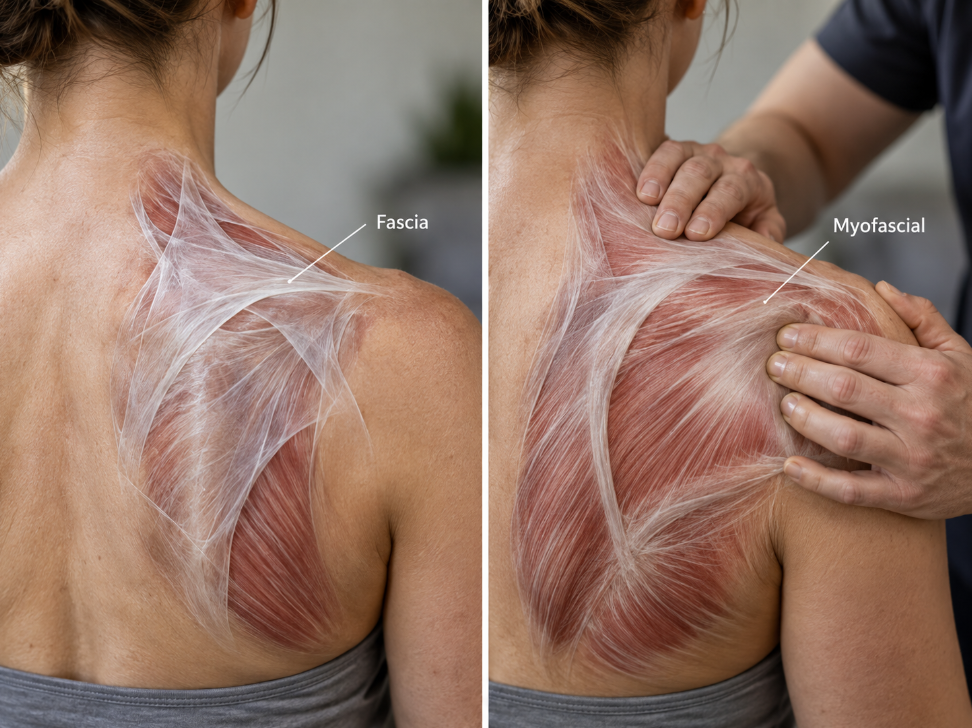
The two words get used interchangeably in wellness marketing and medical settings alike, which is a big part of why patients end up confused about what any of it means. You’ve heard about fascia. You’ve been offered myofascial release. Someone at your gym mentioned foam rolling their fascia. Your massage therapist has a fascia specialty. Your chiropractor offers myofascial therapy. If you’ve tried to figure out whether these are all the same thing, and whether any of them can actually help your pain, you’ve probably come away more confused than when you started.
The good news is the distinction isn’t complicated once you have it. The better news is that once you understand what each term actually refers to, you can also start to see where the honest science ends and the marketing overreach begins. This piece walks through both.
What Each Term Actually Means
Start with the anatomy, because the language flows from the tissue.
Fascia
Fascia is a type of connective tissue that surrounds, supports, and connects almost every structure in the body. Muscles have fascia around them. Organs have fascia around them. Blood vessels, nerves, bones, and joints all have fascia in and around them. It’s not a single organ or a discrete structure. It’s more like a continuous web of connective tissue that runs throughout the whole body, giving structure and separating (but also linking) everything.
For a long time, fascia was treated as passive packing material in anatomy textbooks. Newer research (much of it from the past 15 years) has shown that fascia is more active than that. It contains sensory nerve endings, contractile cells, and adapts to load over time. It plays a role in movement, proprioception (your sense of body position), and possibly pain processing. That research is real and interesting. It has also been enthusiastically overextended by marketers into claims the science doesn’t support.
Myofascial
The prefix “myo” comes from the Greek word for muscle. Myofascial refers specifically to the muscle-and-fascia system, meaning the muscle tissue itself plus the fascia wrapped around and through it. When you hear “myofascial,” think of it as pointing at the specific location where muscles and their surrounding fascia meet, not the whole-body fascia network.
So myofascial is a subset of fascia. All myofascial tissue is fascial, but not all fascial tissue is myofascial. The fascia around your kidneys, for example, is fascial but not myofascial. The fascia sheathing your hamstring is both.
Why the Terms Get Confused in Practice
In clinical practice, most of what practitioners are actually treating when they say either word is the same thing: the muscles and the fascia intimately wrapped around them. When a chiropractor, physical therapist, massage therapist, or bodyworker treats “fascia” or does “myofascial release,” they’re almost always working on muscle-fascia tissue in some region of the body. The tools are often the same (hands, elbows, cupping, instruments, foam rollers). The techniques often overlap. The stated goals often overlap.
This is why the terms get used interchangeably by both providers and patients. In marketing copy, “fascia therapy” and “myofascial therapy” and “myofascial release” often mean essentially the same treatment. The specific brand of the technique (Rolfing, ART, Graston, myofascial release with a specific certification) usually matters more than which term the practitioner uses for it.
Where the distinction genuinely matters is when providers or products claim to be treating “whole-body fascia” or the “fascia network” in ways that go beyond localized muscle-and-fascia work. That’s the space where the science tends to get outrun by the marketing.
What the Research Actually Shows

The honest picture of the current science, without the wellness-marketing overlay:
Manual therapy that targets muscle and fascial tissue can produce measurable improvements in pain and range of motion for many musculoskeletal conditions. The evidence for this is reasonably strong across techniques from massage to instrument-assisted soft tissue mobilization to specific myofascial release protocols. What the research is less clear on is exactly why it works.
The older explanation (the one most “myofascial release” content still relies on) was that fascia becomes chronically shortened or “stuck” and manual pressure can “release” it, restoring normal length and mobility. That mechanism is intuitively appealing but not well-supported by the actual biomechanics research. Fascia is quite strong and doesn’t stretch or reshape as easily as the old narrative suggests. What appears to actually happen involves nervous system changes: reduced protective muscle tension, altered pain signaling, changes in how the brain perceives the treated area.
This matters because it changes what you should reasonably expect from treatment. Manual therapy on muscle and fascia can genuinely help pain and mobility. What it isn’t doing is physically melting or releasing tissue that was permanently stuck. The improvements come from the nervous system’s response to the input, not from the tissue itself being reshaped.
The claims that regularly overreach the evidence: that fascia stores emotional trauma that manual therapy releases, that fascia treatments cure systemic conditions unrelated to musculoskeletal function, that fascia work reshapes body structure in dramatic and lasting ways after single sessions, that specific proprietary techniques access some special layer of fascia that others cannot reach. All of these have marketing appeal. None of them have the evidence base the marketing implies.
When Manual Therapy on Fascia and Muscle Actually Helps
With the marketing overreach set aside, there are real situations where hands-on work targeting muscle and fascia produces meaningful pain relief and functional improvement. In the clinic, these are the patterns where we see the most consistent results:
Chronic muscle tension and trigger points
Localized areas of muscle that have become chronically tight, tender, and often refer pain to other regions. Targeted pressure, sustained holds, and specific techniques can reduce the tension, decrease the referral pain, and restore normal function. This is one of the strongest use cases and where much of the evidence base for myofascial therapy actually sits.
Post-injury tissue restrictions
After a strain, sprain, or surgery, tissue often heals with adhesions or altered mechanics that limit motion. Manual therapy on the affected muscle-fascia region can help restore normal movement patterns, reduce compensatory tension in surrounding areas, and support the rehab exercises that build back function.
Chronic postural pain
The pain patterns that come from years of desk work, driving, or repetitive occupational demands often involve specific muscle groups that have adapted to sustained loading. Manual work on those groups, paired with movement retraining and strength work, can meaningfully reduce the pain and improve daily function.
Acute muscle spasm
The sudden protective spasm that happens after an acute injury or in response to significant stress often responds well to careful manual work that helps the nervous system settle. This is temporary relief that opens the door for more definitive treatment, not a cure in itself.
Pre- and post-activity for athletes
Manual therapy on high-demand muscle groups before or after athletic activity can help with tissue preparation and recovery. The evidence for these applications is more mixed than for the clinical uses above, but many athletes find it useful and it carries low risk when done appropriately.
When to Be Skeptical of Fascia Claims

Because this is a space with real marketing overreach, being able to identify overclaims protects patients from wasting money on treatments unlikely to help. A few warning signs:
Claims that fascia work treats conditions unrelated to musculoskeletal function. Fascia therapy for depression, for autoimmune disease, for chronic fatigue: the underlying mechanisms these conditions involve are not conditions manual therapy on muscle and fascia meaningfully addresses. Overclaiming providers may frame these as “whole-body” benefits. That framing outruns the actual evidence.
Language about “releasing trauma” stored in fascia. Emotional trauma is real and its physical effects are real, but the specific claim that fascia stores emotional memories that manual pressure can release is a metaphor, not a mechanism. Providers who lean on this framing may still be doing useful bodywork, but the language should be a signal to look critically at the broader claims they make.
Long pre-paid packages presented on the first or second visit. Fascia work, like most conservative care, should be reassessed regularly based on how you’re actually responding. Extensive packages sold before any real response can be observed are a business model, not a clinical rationale.
Claims that a specific proprietary technique is uniquely effective in ways others aren’t. Most well-trained bodyworkers using standard techniques produce broadly similar outcomes. When someone insists that only their branded system can achieve specific results, that’s marketing talking, not the evidence.
Refusal to acknowledge limits. Providers who present manual therapy as helpful for essentially any complaint, without ever suggesting that some conditions need different treatment, are either overconfident or underinformed. Good providers know what their tools can and can’t do.
What Good Manual Therapy on Muscle and Fascia Actually Looks Like
The realistic version of what this kind of work does in practice:
A thorough assessment first. A skilled provider looks at your movement, tests specific structures, and identifies the tissue restrictions and movement patterns actually driving your symptoms. They don’t just start pressing on wherever hurts.
Targeted work on the identified areas. Sustained pressure, specific stretches, active release techniques, instrument-assisted approaches: the specific tools depend on the provider’s training and what your body responds to. Techniques can look very different but often produce similar results when applied thoughtfully.
Integration with movement work. Manual therapy alone rarely produces lasting change. Combining it with specific rehab and corrective exercise is what turns short-term relief into durable improvement. Providers who never send you home with anything to do are missing half the treatment.
Honest expectations. Manual therapy generally produces gradual improvement over several sessions rather than dramatic overnight change. Providers who promise big single-session transformations are usually either overselling or working with populations that get placebo benefits from the presentation.
Reassessment along the way. Every few visits, the plan should be reassessed based on how you’re actually responding. Care that isn’t producing meaningful change after a defined trial should change direction, not just continue on inertia.
If You’re Considering Manual Therapy for Persistent Pain
The confusion around “fascia” and “myofascial” terminology mostly doesn’t matter once you understand that both terms usually point at the same category of manual work on muscle and connective tissue. What matters more is finding a provider who applies the work skillfully, is honest about what it can and can’t do, and integrates it with the movement and strength work that produces lasting change.
Cedar Park Chiropractic Relief offers targeted myofascial therapy as one part of a broader conservative care approach that includes adjustments, soft tissue work, and rehab exercise. Dr. Alex Klein takes an evidence-informed view of what manual therapy can realistically accomplish and won’t oversell what it does. If you’re dealing with persistent muscular pain, chronic tension patterns, or tissue restrictions from an old injury, an evaluation is a reasonable starting point to figure out whether this kind of work belongs in your plan. Call (512) 501-6941 or book online.
Common Questions
Is myofascial release the same as massage?
They overlap significantly. Myofascial release is technically a specific set of techniques focused on sustained pressure and slow, prolonged holds on muscle and fascial tissue. Massage is a broader category that includes many techniques, some of which look nearly identical to myofascial release. In practical terms, the specific technique matters less than the provider’s skill and whether the work is targeting the tissue actually driving your pain.
Can foam rolling replace professional myofascial therapy?
For general tissue preparation and maintenance, foam rolling has real value and is worth doing. It doesn’t replace targeted professional work for specific problem areas or complex patterns, because you can’t apply the same precision or reach the same tissue depth as a trained provider. Both have a place. Foam rolling is what you do daily. Professional work is what you do when specific issues need targeted attention.
How many sessions of myofascial therapy will I need?
Depends entirely on the situation, and any provider quoting a specific number before evaluating you is guessing. A reasonable framework is a short trial (typically four to six sessions over four to six weeks) followed by honest reassessment. If meaningful progress is happening, care continues. If not, the plan changes or ends.
Does myofascial work hurt?
Some techniques produce moderate discomfort during application, particularly on tissue with significant restriction or trigger point activity. The discomfort should be tolerable and productive, not intense or damaging. Extreme pain during manual therapy is a signal that the provider is being too aggressive or that the technique isn’t right for your tissue. Mild soreness for a day or two afterward is common and usually clears without intervention.
Can I do myofascial release at home?
Self-treatment tools (foam rollers, lacrosse balls, massage guns) can be useful for general maintenance and for specific areas your provider has taught you to address. Self-treatment has limits: you can’t reach some areas well, you can’t observe your own movement patterns while working, and you may not apply the right technique to specific problems. Best used as a complement to professional care rather than a replacement for it.