
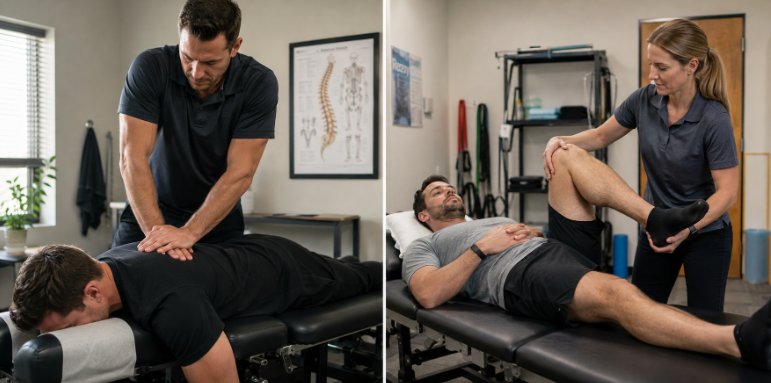
If your problem is pain that keeps coming back to the same spot, start with a chiropractor. If your problem is weakness, or rebuilding after a surgery or an injury, start with a physical therapist.
That covers most people. The rest of this is for the cases where it is not that clean, which is more of them than either profession tends to admit. The two overlap in real ways and diverge in others, and the better first stop depends less on which profession you trust than on what specifically is wrong with you.
What Each Profession Actually Does
Both are licensed doctoral-level healthcare professionals. Both go through rigorous training. Both work primarily on musculoskeletal issues. The differences start with what they emphasize in their training and continues into what a typical treatment looks like.
Chiropractor (Doctor of Chiropractic, DC)
A four-year doctoral program after undergraduate education, roughly 4,800 hours of classroom and clinical training. Curriculum emphasizes biomechanics, radiology and diagnostic imaging, spinal and joint manipulation, and manual therapy techniques. Chiropractors are trained to assess and treat musculoskeletal conditions, particularly of the spine, and to recognize when a condition needs referral out.
A typical chiropractic visit centers on manual assessment and manual treatment. Adjustments (specific manipulations of spinal or joint segments). Soft tissue work on muscles that are restricting motion or driving pain. Range of motion work. Depending on the practice, exercises, ergonomic advice, and follow-up plans. The style of a good chiropractic visit is hands-on and often relatively quick, with an emphasis on getting mechanical dysfunction addressed and the patient moving better before they leave.
Chiropractors are legally allowed to order imaging (x-rays) directly, which some do routinely and others reserve for specific indications. They can diagnose musculoskeletal conditions within their scope. They cannot prescribe medication and, in most states, cannot order MRIs or perform invasive procedures.
Physical Therapist (Doctor of Physical Therapy, DPT)
A three-year doctoral program after undergraduate education. Curriculum heavily emphasizes exercise science, neuroscience and motor control, differential diagnosis, and evidence-based practice. Physical therapists complete extensive clinical rotations across multiple settings, including orthopedic, neurological, acute care hospital, and pediatric environments. That breadth of clinical exposure is one of the defining features of PT training.
A typical PT visit centers on movement assessment and progressive exercise. Manual therapy (adjustments, joint mobilization, soft tissue work) is often part of it but usually not the main event. The main event is teaching you specific exercises and movement patterns, watching how you perform them, cueing you to improve form, and building a progressive program over multiple visits. PT sessions are often longer than chiropractic sessions and involve more hands-on coaching of movement than hands-on treatment.
PTs work across a much broader range of conditions than most people realize. Post-surgical rehabilitation. Post-stroke and neurological recovery. Vestibular rehabilitation for dizziness disorders. Pediatric developmental care. Cardiopulmonary rehab. Wound care in some settings. Most of what they treat outside of orthopedic settings gets no attention in comparison articles, and it’s a meaningful part of the profession.
Where They Actually Overlap
This is the part that both professions sometimes prefer not to acknowledge. For a significant portion of the conditions patients bring in, either a chiropractor or a physical therapist can produce similar outcomes with different methods.
Both perform manual therapy. Both do soft tissue work. Both do joint mobilization. Both prescribe exercises. Both address posture, movement patterns, and functional limitations. Both can help with low back pain, neck pain, headaches, most joint issues, sports injuries in the recovery phase, and general musculoskeletal dysfunction. For these overlap conditions, the specific provider matters much more than the profession. A skilled, engaged chiropractor and a skilled, engaged physical therapist are more similar in their treatment approaches than either would probably admit.
The overlap is the reason so many patients get confused. If both can help, how do you choose? The honest answer is: for the overlap conditions, either one is a defensible first choice, and the specific provider you find matters more than which letters are after their name. For the conditions outside the overlap, the choice is much clearer.
Where They Really Differ
Now the honest differences, without shading in either direction.
Chiropractors do more high-velocity, low-amplitude spinal manipulation than PTs typically do. If you want that specific technique, chiropractic is where the emphasis lies. The adjustments most people think of when they picture chiropractic care (the specific movements with the audible pop) are a chiropractic specialty, and chiropractors typically have significantly more hands-on training in performing them than PTs do.
Physical therapists do more progressive exercise prescription than chiropractors typically do. If your problem requires building specific strength, retraining specific movement patterns, or working through a graduated return-to-activity program, PT is generally the deeper toolkit. PT training is centered on exercise science in a way chiropractic training is not.
Physical therapists have broader clinical exposure to neurological and post-surgical conditions. If you’re recovering from a stroke, managing multiple sclerosis, working through a total joint replacement, or dealing with a complex neurological issue, PT is where the training and clinical experience live. Chiropractors treat these populations sometimes, but the depth of training is not comparable.
Chiropractors typically see patients more frequently in the short term, particularly during acute care. Two or three visits a week for a few weeks is a common pattern for an acute back or neck issue. PT tends to space visits more (typically once or twice a week) with more homework between sessions. This affects both cost and time investment.
Insurance coverage tends to be broader for PT than for chiropractic in most plans. Chiropractic is often covered but with lower visit limits and more restrictions. This isn’t a clinical difference but it’s a practical reality that affects the decision.
What Your Situation Actually Calls For

The question isn’t which profession is better in general. It’s which one fits your specific situation better. Here’s the honest matchup for the most common scenarios that bring people to comparison-shopping in the first place.
Acute Back or Neck Pain That Came on Recently
Chiropractor is usually a reasonable first step. The mechanical dysfunction driving acute pain often responds well to adjustments and soft tissue work in a way that’s fast and targeted. If a few visits over a couple of weeks produce meaningful improvement, great. If they don’t, or if the issue turns out to be more complex than initially assessed, the plan should shift toward more progressive rehab or a different provider entirely.
Post-Surgical Rehabilitation
Physical therapist. Not close. Rehabilitating after a joint replacement, ACL reconstruction, spinal surgery, or any other significant orthopedic procedure requires progressive rehab expertise, close coordination with the surgical team, and often specific protocols that PT training is built around. Chiropractic care may play a supporting role in specific situations, but PT is the primary lane here.
Chronic Pain That’s Been Going on for Months
Physical therapist tends to be the better long-term fit, though many patients benefit from starting with a few chiropractic visits to address any mechanical restrictions before shifting into progressive rehab. Chronic pain rarely resolves with hands-on treatment alone, and the movement retraining and progressive loading work that changes chronic patterns is PT’s home turf.
Sports Injury During Training
Depends on where you are in the injury. Acute phase: chiropractor if the issue is mechanical (a joint that’s stuck, muscle spasm, altered movement pattern that needs restoring). Rehab phase: PT if the issue requires progressive loading, sport-specific retraining, or a return-to-play program. Many athletes do best seeing both at different points in the recovery.
Recovering From a Car Accident
Either can help, and both are commonly involved in auto injury cases. Chiropractic often addresses the mechanical dysfunction that comes with whiplash and impact injuries relatively directly. PT handles the progressive return-to-function work. Insurance considerations (Texas PIP typically covers both) usually don’t force a choice between them. Many patients benefit from a chiropractor early and a PT for the longer arc of recovery.
Post-Stroke, Neurological, or Complex Medical Recovery
Physical therapist. This is squarely PT’s clinical wheelhouse and outside typical chiropractic scope. If you or a family member is recovering from a stroke, working through a neurological condition, or managing a complex medical picture, PT is the right primary rehabilitation partner.
For vestibular rehabilitation specifically (dizziness and balance disorders, including BPPV), both PTs and chiropractors with the right specialty training can help. Look for the specialty training, not the letters.
Pregnancy-Related Musculoskeletal Pain
Both can help, and the choice often comes down to provider training. Look for a chiropractor with prenatal-specific training or a physical therapist with pelvic health training. The prenatal population has specific needs and neither profession’s baseline training necessarily prepares providers for it without additional coursework.
Kids or Teens with Sports Injuries
Depends on the injury, but PT is often the safer first choice for growing bodies with complex injuries because of the depth of pediatric training available in the profession. Chiropractic care can be appropriate for specific mechanical issues in older teens with an experienced provider. Younger children with significant injuries usually need pediatric orthopedic evaluation first.
You Mostly Feel Fine and Want to Stay That Way
Honestly, neither is strictly necessary. Consistent movement, appropriate strength training, good sleep, and stress management are the foundation. Occasional maintenance care with either profession can be reasonable, but be wary of anyone selling you an indefinite treatment plan for a body that’s basically working. The healthiest people don’t need weekly adjustments or standing PT appointments.
When You Actually Need Both
Some situations really do call for collaborative care between the two professions, and the best providers of either type recognize this and refer accordingly.
Complex chronic pain that has both mechanical and movement pattern components. The chiropractor addresses the mechanical restrictions. The PT rebuilds the movement patterns and strength. Neither alone typically produces lasting results for these situations.
Sports injuries in athletes who need to keep training. The chiropractor keeps mechanical dysfunction from cascading into worse issues. The PT builds the specific capacity needed for the sport. This is a common combination for competitive athletes and often produces better outcomes than either provider alone.
Auto injury cases with both acute mechanical injury and longer-term functional deficits. The chiropractor addresses the acute mechanical picture. The PT manages the return-to-function work. Insurance (specifically Texas PIP) typically supports both without either forcing the other out.
The reasonable expectation with collaborative care is that both providers communicate about your plan. If your chiropractor and PT are treating you in isolation without ever talking to each other, you’re not getting collaborative care, you’re getting parallel care. That’s still often useful but it’s not the same thing.
When You Might Need Neither
Honest scope requires naming the situations where the answer to “chiropractor or physical therapist?” is actually “neither, at least not yet.”
Serious traumatic injuries. If you were just in a significant accident, fell from height, or sustained direct trauma to the head or spine, urgent care or emergency evaluation comes first. Chiropractic and PT are not the first step for actual trauma.
Suspected fractures, tendon ruptures, or ligament tears with significant functional loss. These need orthopedic evaluation, usually with imaging, before conservative care. Starting with a chiropractor or PT for a suspected Achilles rupture wastes time you can’t afford.
Systemic symptoms alongside musculoskeletal complaints. Unexplained weight loss, night sweats, fever, cancer history with new onset back pain, or other red flags all need medical evaluation before conservative care. A responsible provider in either profession will refer these out immediately.
Progressive neurological deficits. Increasing weakness, bowel or bladder changes, spreading numbness, or new balance problems can indicate serious underlying conditions. Medical evaluation first.
Simple everyday soreness that resolves on its own. Not every ache needs a provider. If you’re generally healthy and something is sore for a few days without other concerning features, appropriate rest, movement, and time often resolves it without any professional care.
How to Choose Well Within Either Profession

This is what most comparison articles skip, and it’s probably more important than which profession you pick. A great chiropractor is a better choice than a mediocre PT. A great PT is a better choice than a mediocre chiropractor. Provider quality varies enormously within both professions, and the signals that indicate a good provider apply regardless of the letters after the name.
Signs of a provider worth seeing:
- They take a real history and do a thorough exam before treating anything. If you’re on the table getting adjusted within five minutes of walking in, that’s a sign the assessment is thin. Good providers spend time understanding your situation before they touch you.
- They give you an honest estimate of the timeline and what you’ll need. “Come in twice a week for the next six months” with no clinical reassessment points is a business plan, not a care plan. Good providers set expectations, reassess regularly, and adjust the plan based on how you’re actually responding.
- They teach you what to do between visits. If every visit is 100 percent hands-on treatment and no education or exercises, you’re not getting the tools to eventually not need them. Good providers work to make themselves less necessary over time, not more.
- They refer out when they should. A provider who thinks they can treat everything within their scope is either overconfident or underinformed. A good chiropractor tells you when you need a PT, a physician, or an orthopedist. A good PT tells you when you need a chiropractor, a physician, or an orthopedist. This is the single strongest signal of clinical judgment.
- They don’t sell you expensive packages up front. Long pre-paid treatment plans presented at the first or second visit are almost never in your interest. The plan should evolve based on how you respond, not lock you in before your body has had a chance to tell you what it needs.
- They stay current with evidence. The chiropractic and PT professions have both evolved significantly in recent decades. A provider stuck in decades-old thinking (about ice for injuries, about the value of rest, about the exclusive centrality of manipulation for chiropractors) is less useful than a provider engaging with current research.
If You’re Still Not Sure
The honest answer for most people in the Cedar Park area is: start with whichever profession’s scope fits your specific situation better based on the scenarios above. If you’re between the two, start with the one that’s more accessible (in-network for your insurance, closer to home, has openings within a reasonable timeframe). Give it a defined trial period. Reassess. Change providers or professions if the initial choice isn’t producing results.
If your situation feels like it might be in the chiropractic wheelhouse and you’d like an evaluation from a provider who will tell you honestly if it’s not, Dr. Alex Klein at Cedar Park Chiropractic Relief works within a defined scope, refers out when appropriate, and won’t pretend chiropractic is the answer to everything. The first visit is a real evaluation and a straight read on whether conservative care is your best path forward. Call (512) 501-6941 or book online.
If your situation is clearly more of a PT case based on this article, our office can also help point you toward well-regarded physical therapy providers in the area. Getting you to the right care matters more than getting you to our office.