

The Austin Marathon runs in February each year. If you’re training for it, or one of the half marathons that share the course, your training calendar is already doing the math for you. Sixteen weeks out. Twelve weeks out. Peak week. Taper. Race day. Every runner reading this has a version of that calendar in their head, and every runner knows how much of their success depends on what happens between the runs, not just on the runs themselves.
Marathon training is a physiological negotiation with your own body. You’re asking it to adapt to progressively harder demands over months, without breaking down along the way. Most runners who don’t reach race day (or reach it undertrained, injured, or half-hearted) got sidelined by an injury they could have prevented, an injury they trained through instead of addressing, or a recovery week they skipped because they felt fine. This article walks through what your body actually needs at each phase of a marathon training cycle, with the specific realities of Austin running woven in.
This isn’t a training plan. Your coach or your training group has that covered. This is about what happens to the body in each phase, what the injury risks look like, and what to do to stay healthy from base building through race day and past it.
Base Phase (16 to 10 Weeks Out): Building Without Breaking
The base phase is where you build the aerobic engine and the tissue tolerance that the rest of the cycle will draw from. In the Austin heat, this often means starting mileage buildup while temperatures are still uncomfortable, which affects pace, fluid needs, and recovery. If you’ve been running consistently through the summer, your body is somewhat adapted. If you’re returning from a break or ramping up from a smaller base, this is the phase where you’re most vulnerable to overuse injuries that will haunt the whole cycle.
The specific pattern we see: runners come out of a lower-volume period, get excited about training for a specific race, and add weekly mileage faster than their connective tissue can adapt. Muscles adapt quickly. Tendons, ligaments, and bones adapt on much slower timelines, sometimes 8 to 12 weeks behind muscle. When you add volume faster than that adaptation window, you get the overuse injuries that dominate the running injury clinic: patellofemoral pain (runner’s knee), IT band syndrome, plantar fasciitis, Achilles tendinopathy, tibial stress reactions.
The 10 percent rule (increase weekly mileage by no more than 10 percent per week) is a starting heuristic, not a hard science. Some runners can push more, some need less. What matters is that the ramp is gradual and that you back off proactively when your body signals it’s not adapting. Nagging soreness that doesn’t clear between runs, joint pain that shows up early in a run, unusual fatigue that lingers into the next day: these are your body’s early warning system. Ignoring them in the base phase almost always produces bigger problems six weeks later.
What Matters in the Base Phase
Consistent low-intensity mileage over speed work. Base is for aerobic development, not for intensity. Save the hard efforts for later phases when your tissue tolerance can support them.
Strength training two to three times per week. Runners who don’t lift weights end up with the same weaknesses that every other runner-only athlete has: weak glutes, weak core, weak posterior chain, poor single-leg stability. All of these contribute to injury risk once the mileage climbs.
Address old injuries before they become new ones. The niggle in your left hip from last training cycle? The Achilles that gets stiff after every long run? These are things to sort out now, while the volume is manageable. In eight weeks, when you’re running 40-plus miles a week, the same niggle will be a full injury.
Heat acclimatization if you’re training through Austin’s warm months. Your body adapts to heat over about 10 to 14 days of consistent exposure. Skipping outdoor runs entirely and doing everything indoors delays that adaptation. Pace naturally drops in heat. Trying to hit “normal” paces in high heat produces the exact kind of stress and hydration issues that derail training.
Build Phase (10 to 4 Weeks Out): Where Most Injuries Actually Happen

The build phase is where the real work happens. Long runs stretching into the high teens and low twenties. Speed sessions. Threshold work. The peak weeks that stack the highest total volume of the cycle. It’s also where the majority of marathon-training injuries happen, and for a specific reason: this is when your training stress accumulates faster than your recovery can keep up.
Every runner has a threshold where training load exceeds recovery capacity. When you’re above that threshold for too long, tissue quality degrades, form breaks down under fatigue, and small compensations become bigger ones. The 22-mile long run is not what causes IT band syndrome. The cumulative fatigue that made your gait shift over the past four weeks is what caused it. The long run just made it symptomatic.
The Austin-specific consideration in this phase is the hills. If you’re training for the Austin Marathon specifically, the course has real climbs (the Congress Avenue finish is uphill, and there are challenging hills throughout the middle miles). Runners who train exclusively on flat routes and then race a hilly course end up with quad damage they didn’t train for. Hill training in the build phase serves double duty: it strengthens the specific muscles the race will demand and it teaches your body to handle the downhill impact that flat training doesn’t prepare you for.
The Brushy Creek Regional Trail and the Cedar Park hilly loops give local runners access to real elevation work without driving into central Austin. Using them regularly during the build phase pays off on race day.
What Matters in the Build Phase
Recovery is training. This is the single most under-executed principle in amateur marathon training. Easy days need to be actually easy (conversational pace, not a slightly slower version of tempo). Sleep needs to be prioritized. Nutrition needs to actually match energy output. If any of these are off, the hard days you’re putting in aren’t producing adaptation, they’re producing accumulated stress.
Address pain and stiffness immediately, not eventually. In the build phase, the temptation to push through soreness is at its highest because you’re afraid of losing fitness. But this is exactly the phase where minor issues become injuries that end training cycles. Myofascial therapy for stubborn muscle knots and targeted rehab work on weak links keeps small problems from becoming season-ending ones.
Cutback weeks are non-negotiable. Every three to four weeks, your body needs a step-down in volume to consolidate the adaptation you’ve been building. Runners who skip cutback weeks because they “feel good” almost always break down in the following block. Feeling good means the plan is working. It’s not a signal to work harder.
Watch for the specific injury patterns of this phase. Runner’s knee often shows up in the build phase because increased volume unmasks glute weakness that couldn’t stay hidden anymore. IT band syndrome appears from cumulative mileage and altered gait. Plantar fasciitis develops when calf tightness meets increased loading. All of these have a window where conservative care resolves them quickly. Wait too long and they become the injuries that don’t clear until after the race.
Taper (3 to 1 Weeks Out): Where Injuries Get Ignored
The taper is emotionally the hardest phase for most marathoners. Volume drops. Intensity mostly holds. Free time appears where long runs used to be. Runners feel restless, uncertain, and worried they’re losing fitness. All of that is normal. Fitness doesn’t disappear in three weeks. What can disappear is the accumulated fatigue you’ve been carrying, which is the whole point of the taper.
The specific injury risk of the taper is different from the build phase. Because volume drops, most acute mechanical overuse decreases. But this is when a few problems become obvious: injuries you’d been managing through fatigue become clearer as fatigue clears; issues that were building in the background can suddenly become symptomatic; and (dangerously) runners with lingering issues sometimes convince themselves they can add a “tune-up” workout or a “confidence-building” long run that reintroduces load their body needed to recover from.
The two biggest taper mistakes we see:
First, adding volume back because you feel underworked. Trust the plan. If your training program calls for reduced mileage, take it. Adding an extra long run in taper week has cost more marathons than it has saved.
Second, ignoring niggles because you’re two weeks out and don’t want to hear bad news. This is exactly when to get evaluated. A minor issue caught during taper has a real chance of being managed through race day. The same issue ignored until the day before the race becomes something you race with, or worse, don’t race at all.
What Matters in the Taper
Prioritize sleep. Your body does its adaptation work during sleep. Taper is when you can finally give it enough of that time.
Address any remaining tissue issues now. Soft tissue work, adjustments, and targeted mobility can all help in the taper window. The goal is to arrive at race day with tissue that’s fresh, loose, and ready to work.
Practice race-day nutrition and pacing on your taper long runs. Test what you’ll eat pre-race, what you’ll take during, and how it sits with your body at goal pace. Race day is not the time for experiments.
Manage the mental game. Taper anxiety is real. Runners get twitchy, sleep worse, obsess over hypothetical scenarios. Some of that is unavoidable. What helps: sticking to the plan, keeping your usual routines, avoiding drastic changes in anything (diet, sleep schedule, workout structure) in the last two weeks.
Race Week: The Body Care You Should Actually Be Doing
Race week has its own rhythms and its own mistakes. The body work in this window is about preparation and preservation, not about squeezing out another percent of fitness.
Monday to Wednesday: light runs, some strides to keep the legs sharp, normal sleep, normal food. If you get any manual therapy this week, get it early (Monday or Tuesday), not late. Deep tissue work three days out is fine. Deep tissue work the day before the race is a bad idea because your body needs time to process it and any soreness or altered movement patterns need time to settle.
Thursday to Friday: taper the taper. Very light running or complete rest. Prepare your gear, review the course, make sure everything you’re going to wear or use on race day has been tested. Hydration should be steady but not excessive. Sleep should be prioritized. If Thursday night sleep is bad, don’t panic. Two nights before race night matters more than the night before.
Saturday: pick up your bib, do a short shakeout run, eat well but don’t do anything unusual, get to bed early. This is when nervous energy is highest. Accept it, don’t fight it.
Sunday: whatever you’ve been doing that works. Trust your training. The race is what it is at this point. Your body has been prepared for months. The last week doesn’t change that.
After the Race: The Recovery Nobody Trains For
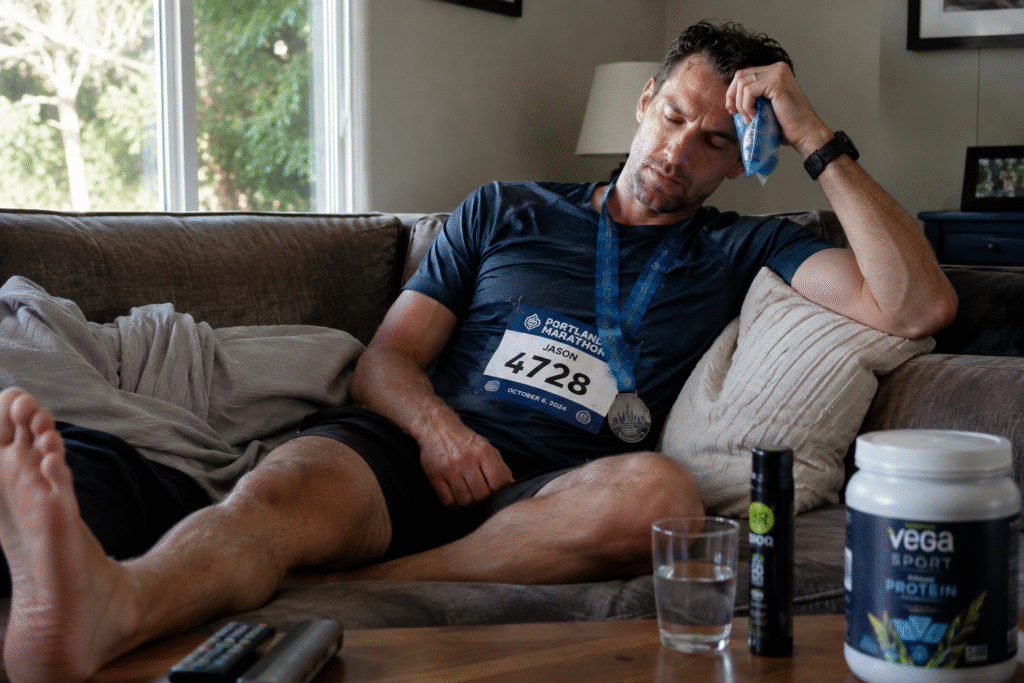
This is the phase most runners get wrong, because there’s no training plan telling them what to do. The Austin Marathon ends. You collect your medal. You eat. You go home. And then what?
The physiological reality: you’ve just done significant damage to muscle tissue, connective tissue, and metabolic systems. Marathons produce measurable elevations in inflammatory markers, cardiac stress markers, and muscle damage markers that take days to weeks to normalize. Your immune system is temporarily suppressed. Your musculoskeletal system needs real recovery time.
The pattern that gets runners into trouble: feeling okay on Wednesday, running easy on Friday, doing a longer effort the following week, then dealing with an injury three weeks later that they can’t figure out. What happened: they were still recovering from the marathon and layered new training stress on top of unresolved tissue damage.
What Matters in Post-Race Recovery
Take at least a full week off from running. Walking is fine. Light cross-training (swimming, easy cycling) is fine if it feels good. Running is not. This is unpopular advice and it’s still correct.
Return to running very gradually. The old “reverse taper” concept holds up. If you tapered over three weeks, spend three weeks building back. Short easy runs first. No long runs for at least two weeks. No speed work for three.
Address anything that hurts. Post-marathon is when accumulated issues that got masked by adrenaline and race-day carbs become obvious. This is a good time for a conservative care evaluation to catch anything before it becomes chronic.
Give yourself psychological recovery time too. Post-race blues are real. The buildup, the race, and the abrupt end of a months-long process produces genuine emotional letdown for many runners. Plan something to look forward to. Reconnect with parts of life that got de-prioritized during training.
The Mental Game Nobody Wants to Talk About
Runners are, as a population, uniquely bad at listening to their bodies. The sport self-selects for people willing to push through discomfort, which is a strength during hard workouts and a liability when the discomfort is your body telling you something is actually wrong.
The internal dialogue we hear in the clinic: “I don’t want to lose fitness.” “I can’t take time off, my race is in six weeks.” “It’s not that bad, I can push through it.” “If I stop now, I’ll never come back.” All of these are the voice of the runner’s identity talking. None of them are the voice of the runner’s body.
Here’s the honest math. Missing three to seven days of running to address an injury early costs you almost nothing in fitness. Continuing to run on that injury for three to seven weeks costs you a training cycle, potentially a race, and often several months of recovery that could have been days. The runners who consistently reach race day are not the ones who train hardest. They’re the ones who know when to back off and don’t romanticize suffering.
The single most useful skill for staying healthy through a marathon cycle is being able to distinguish between the discomfort of training and the discomfort of injury. Training discomfort tends to be symmetrical, tends to clear with warm-up, and tends to stay stable or improve with continued running. Injury pain tends to be one-sided, tends to worsen with continued running, and tends to change how you move. When in doubt, err on the side of stopping. Days off are always cheaper than weeks off.
When Something Goes Wrong at Any Stage
Injuries happen. Even in cycles where everything is going well. The question is not whether to expect them but how to respond when they show up.
The general framework: for anything that’s been bothering you for more than a few days and isn’t clearing between runs, get it evaluated. Not by Google. Not by a running buddy. By someone qualified to actually assess it. Most running injuries have a window where conservative care can resolve them relatively quickly. Miss that window and the timeline gets much longer.
Situations that warrant immediate attention rather than wait-and-see:
- Sharp, localized bone pain, especially in the tibia, foot, or hip. Stress fractures need imaging and specific management. Running through them turns a 6 to 8 week problem into a much longer one.
- Pain that changes your gait. If you’re limping or compensating, you’re now creating a new problem on top of the original one.
- Pain that wakes you up at night or is progressively worsening. Mechanical injuries typically improve with rest. Pain that gets worse without you doing anything deserves a closer look.
- Numbness, tingling, or weakness in a limb. Points to nerve involvement that needs evaluation beyond typical running injury care.
- Any injury following a specific traumatic event (a bad step, a fall, a pop or snap sensation). Get evaluated to rule out something structural.
If You’re Training and Something Feels Off
The best time to see a chiropractor during marathon training is not when you’re already sidelined. It’s when you’re 12 weeks out and something has started to nag. It’s when you finish a long run and one hip is talking to you in a way it wasn’t a month ago. It’s when your calf keeps tightening up on the third mile of every run and you’re not sure why.
Dr. Alex Klein at Cedar Park Chiropractic Relief works with Austin-area runners across the full training cycle, from base building through post-race recovery. The first visit is a proper evaluation, an honest read on what’s driving the issue, and a plan that fits where you are in your training. If conservative care can address it, great. If it needs a sports medicine physician or imaging, you’ll get a clear referral.
Call (512) 501-6941 or book online. Especially if you’re training for Austin, the taper is not the time to wait and see.
Common Questions from Runners in Training
How much running is too much?
It depends on your history, current tissue tolerance, and specific goals. The traditional 10 percent rule (don’t increase weekly mileage more than 10 percent) is a useful starting heuristic but isn’t universal. What matters more is that you’re building gradually, watching for early warning signs, and taking cutback weeks. If your body is adapting well, you can often push more. If it’s protesting, back off, regardless of what the calendar says.
Should I stretch before or after running?
After is more valuable than before for most runners. Static stretching before a run can temporarily reduce muscle performance. A dynamic warm-up (leg swings, walking lunges, light drills) prepares tissue better. Save the longer, held stretches for post-run when tissue is warm and pliable. Mobility work throughout the day (not just around runs) matters more than either.
Do I really need to strength train while marathon training?
For injury prevention and running economy, yes. Runners who add two short strength sessions per week consistently show better injury outcomes than runners who don’t. The sessions don’t need to be long or heavy. Bodyweight or moderate resistance work targeting glutes, core, and single-leg stability is enough. The runners who claim they don’t have time are usually the ones who spend that time later in physical therapy.
What’s the best surface to train on?
Variety beats any single choice. Running exclusively on concrete is hard on joints. Running exclusively on soft surfaces (grass, trail) doesn’t prepare tissue for race-day impact. A mix of surfaces produces the best long-term durability. If your race is on pavement, most of your training should include some pavement work, but not all of it.
Can I run through Austin’s summer heat while training?
You can, and you’ll need to adjust. Heat acclimatization takes about 10 to 14 days of consistent exposure. Once acclimatized, pace naturally runs 30 to 60 seconds per mile slower in high heat compared to cool conditions. Trying to hit “normal” paces in high heat produces exactly the kind of physiological stress that leads to overtraining and injury. Early morning runs are the most manageable. Hydration and electrolyte replacement matter more than most amateur runners give them credit for.
How do I know if my knee pain is runner’s knee or something worse?
Runner’s knee (patellofemoral pain syndrome) typically presents as diffuse pain around the front of the kneecap, worse with running downhill, going down stairs, or sitting for prolonged periods. Sharp pain in specific locations, swelling, locking, giving-way sensations, or pain that follows a specific twisting injury suggest something structural (meniscal injury, ligament issue) that needs evaluation beyond conservative care.
Should I see a chiropractor or a physical therapist for a running injury?
Both can help, and they overlap significantly in what they treat. For most soft tissue running injuries, either is a reasonable choice. The specific provider matters more than the profession. Look for someone who works with runners, understands training cycles, and will communicate with your coach if appropriate. Some runners benefit from seeing both at different points in their care.