

Something happened on the field, the court, or just getting up off the couch wrong, and now the inside of your knee is angry. Maybe you got hit from the outside during a pickup game. Maybe you planted your foot and twisted to change direction and felt something give. Either way, you’re left holding your knee wondering if this is a ligament problem or a cartilage problem, because those are two very different roads to recovery.
Nobody can tell you for certain over the internet. But your knee has already been giving you clues, in the way it hurt when it happened, the way it’s swelling now, and what it does and doesn’t let you do. This guide walks through those clues in the order you’d actually notice them.
Start With How It Happened
Before anything else, think back to the moment of injury. It’s often the single best clue you have.
A hit from the outside that buckled your knee inward
This is a classic setup for a medial collateral ligament (MCL) sprain. The MCL runs down the inside of your knee, and its whole job is resisting exactly that kind of sideways force. According to StatPearls, the MCL is the most commonly injured knee ligament, and it’s involved in about 60% of skiing injuries alone, where a fall often twists the knee sideways. The American Academy of Orthopaedic Surgeons puts MCL tears at up to half of all knee injuries, with the usual cause being a hit to the outside of the leg or a sudden, forceful change in direction.
A twist with no contact at all
If nobody hit you and you just twisted while your foot was planted, that points toward the meniscus instead, the cartilage cushion between your thighbone and shinbone. A pivot, a deep squat, or even rising awkwardly from a low chair can tear it, especially as the meniscus ages and gets less forgiving. As people get older, this kind of tear can happen from something as ordinary as a bad step off a curb.
Sometimes both happen at once. The outer edge of your meniscus is anchored to the deep fibers of the MCL, so a strong enough sideways force can injure both structures together.
What Your Knee Is Doing Right Now
This is where the real detective work happens. Walk through each of these and see which side your symptoms land on.
Where does it actually hurt?
Press along the inside of your knee. If the sore spot runs in a vertical line above the joint itself, like a bruised stripe, that’s the MCL. If the tenderness sits right at the joint line, the horizontal crease where your thigh bone meets your shin bone, and it feels deeper, that’s much more consistent with the meniscus. This test is genuinely useful. Research on knee exams shows joint-line tenderness correctly identifies a meniscus tear roughly 83% of the time.
How fast did it swell?
This is often the best free clue you have, because you don’t need to do anything to check it, you just have to remember. A meniscus tear usually doesn’t swell right away. Many people can still walk on it initially, and the knee gradually stiffens and puffs up over the next two to three days. An MCL sprain tends to swell locally, right over the ligament, rather than filling the whole joint.
If your knee swelled up fast and hard within the first hour, that’s a different and more urgent signal. That kind of rapid, tense swelling usually means something is bleeding inside the joint capsule itself, which points toward an ACL tear, a larger meniscus tear, or a fracture, not a simple sprain.
Does it lock, or does it feel loose?
This is the cleanest divide of all. A torn piece of meniscus can physically wedge itself between the bones, so the knee catches, clicks, or refuses to fully straighten. That’s a mechanical problem, cartilage getting in the way. An MCL sprain doesn’t do that. Instead, it feels loose or unstable, like the knee might give out sideways when you put weight on it. If your knee gets stuck, think cartilage. If it feels like it might buckle, think ligament.
The Player Nobody Mentioned: Your ACL
There’s a third structure worth knowing about, because it can look like either of the other two at first. The ACL sits deep inside the joint and controls rotation and forward sliding of the shinbone. Per OrthoInfo, it’s torn without any contact at all in most cases, often during a pivot or an awkward landing, and it usually comes with a loud pop and swelling that shows up within a day. Female athletes tear their ACL at two to eight times the rate of male athletes in comparable sports.
If your injury involved a pop, fast swelling, and a knee that feels unstable when you turn, mention the ACL to whoever examines you. And if your symptoms don’t cleanly match MCL or meniscus, an ACL injury, or more than one structure injured together, is often why.
Three Things You Can Safely Check at Home
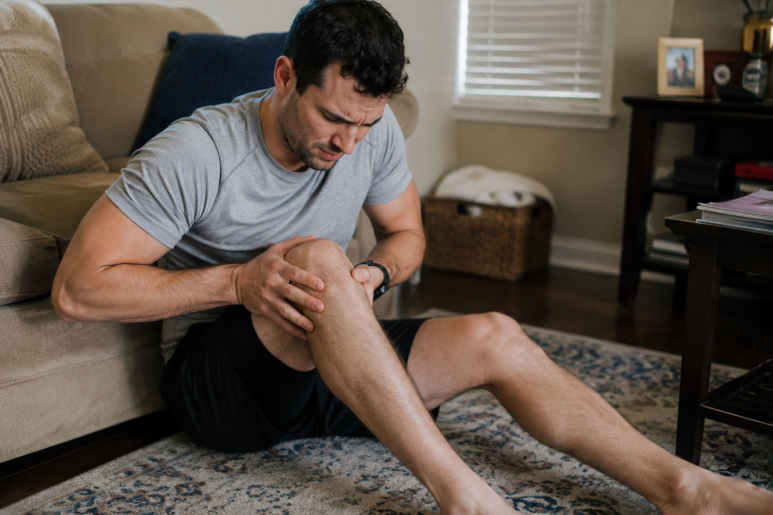
A few words of caution before you try any of these. Skip all of them in the first few days after a significant injury. Skip them if you can’t put weight on the leg. And stop the second something hurts sharply, that’s your answer, and pushing further only aggravates things.
Press along the joint line
Sit with your knee bent to about 90 degrees. Gently press along the crease at the joint itself, then trace upward along the MCL band, comparing side to side with your other knee. Soreness at the joint line leans meniscus. Soreness in a stripe above it leans MCL.
Try a gentle straighten-and-rotate
Slowly straighten your knee with a small amount of rotation at the foot, and notice if it clicks or catches painfully. Don’t force it.
Stand and rotate over the planted leg
Only try this if you can bear weight comfortably. Hold onto a counter, bend your knee slightly, and rotate your body inward and outward over your foot. This is one of the more reliable home checks, though it still isn’t a diagnosis on its own. A positive result here, real pain rather than just discomfort, is worth mentioning to whoever examines you.
None of these tests are conclusive by themselves. But if three or four of them point the same direction, that pattern means something.
How Long Is This Actually Going to Take?
This depends heavily on grade and location, so think in ranges rather than promises.
MCL sprains, by grade
MCL sprains are graded on a simple scale. A grade 1 sprain, stretched but intact, typically calms down over a couple of weeks. A grade 2, a partial tear that’s looser than normal, tends to run several weeks to a couple of months. Most grade 1 and 2 MCL injuries are treated without surgery. A grade 3, a complete tear, is a different conversation, and it’s frequently paired with an ACL tear, which is why it needs an orthopedic opinion rather than a wait-and-see approach.
Meniscus tears, by location
Meniscus tears split by location instead of grade. The outer third of the meniscus has decent blood flow, so tears there have a real chance of healing on their own or being surgically repaired. The inner two thirds has almost no blood supply, so tears there don’t knit back together, and if they stay symptomatic, they’re usually trimmed arthroscopically rather than repaired.
Two things worth knowing that surprise people: a meniscus tear showing up on an MRI doesn’t automatically mean you need surgery, plenty are managed conservatively. And a knee that feels totally normal at three weeks can still be unprepared for cutting and pivoting sports at six weeks. Feeling fine and being ready are not the same thing.
What Actually Helps While You Figure This Out
In the first few days, the goal is calming the joint down without shutting it down completely. That means relative rest rather than total rest, along with compression, elevation, and using ice or heat at the right times to keep pain and swelling under control.
Once the acute swelling settles, the real work becomes loading the knee back up: strengthening the quad and hamstring, retraining hip control, working on single-leg balance, and gradually returning to the movements that caused the problem in the first place. This phase does most of the heavy lifting, and it’s the one most people rush or skip. Manual therapy to the hip and ankle can also help restore motion that swelling stole from you.
Athletes working back toward a season need more than that, they need a progression through actual cutting and landing mechanics, which is exactly what good chiropractic care for athletes is built around.
When This Isn’t a Wait-and-See Situation
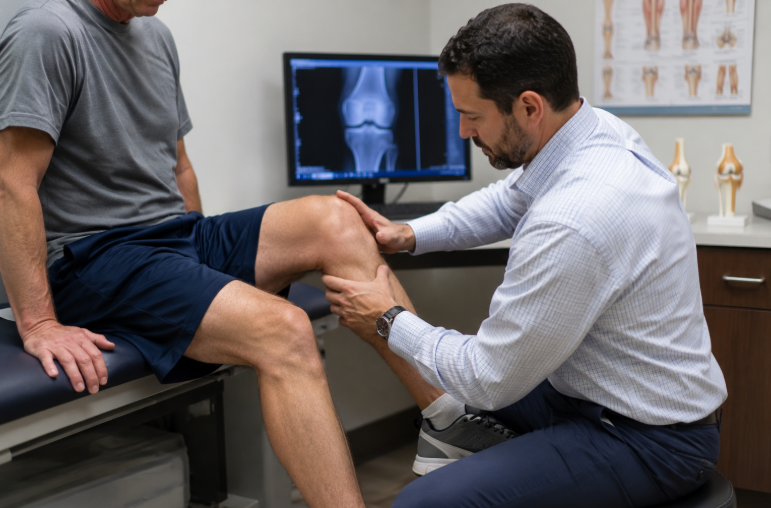
Conservative care handles a lot of knee injuries. It doesn’t handle all of them, and knowing the difference matters.
Get to urgent care or the ER the same day if
- You can’t put any weight on the leg
- The knee swelled dramatically within the first hour
- The knee looks visibly out of place, or you felt it shift and then pop back
- Your foot feels numb, cold, or you can’t find a pulse in it
Get an orthopedic evaluation this week if
- The knee locks, catches, or won’t fully straighten
- It gives way when you walk or turn
- Two weeks of sensible home care hasn’t improved things
- You have obvious side-to-side looseness in the joint
X-rays don’t actually show ligaments or cartilage, they’re there to rule out a fracture. An MRI is the real imaging tool for both of these injuries. But a thorough hands-on exam can diagnose most ligament injuries on its own, which is why the exam should always come before you’re sent for a scan, not after.
Get a Straight Answer About Your Knee
If you’re in Cedar Park, Leander, or the north Austin area and your knee has been a mystery for more than a week, Dr. Alex Klein at Cedar Park Chiropractic Relief will give you a direct assessment, not a guess. Your first visit includes a hands-on exam, a look at what your hip and ankle might be contributing, and a plain-language explanation of what we find. If you need a surgeon, you’ll hear that and get referred out. If conservative care fits, you’ll leave with an actual plan.
Call (512) 501-6941 or book online.
Frequently Asked Questions:
Could I have hurt both my MCL and my meniscus?
Yes, it happens more than people expect. Since the meniscus is anchored to the deep MCL fibers, a strong enough sideways force can injure both together. If your symptoms are pointing in two different directions at once, that’s often the reason.
Is it normal to still be able to walk after a meniscus tear?
Yes. Many people can walk, and some athletes even keep playing, right after tearing a meniscus. The swelling and stiffness often build gradually over the following two to three days rather than hitting immediately, which is different from how an MCL sprain or ACL tear tends to behave.
Do the at-home tests actually mean anything?
They’re screening checks, not diagnoses. Some, like standing and rotating over the planted leg, perform reasonably well in research, correctly flagging a meniscus tear more often than not. But none of them rule out an injury with a negative result. A positive is worth mentioning to a provider. A negative doesn’t mean you’re in the clear.
Can a chiropractor actually treat this, or do I need a surgeon?
For grade 1 and 2 MCL sprains, and for meniscus tears that aren’t locking the joint, conservative care combining hands-on treatment, mobility work, and progressive strength training is often a reasonable path, sometimes alongside your physician. What conservative care can’t do is repair a complete tear or unlock a knee that’s mechanically stuck. Getting an honest read on which category you’re in is the whole point of a good first exam.